
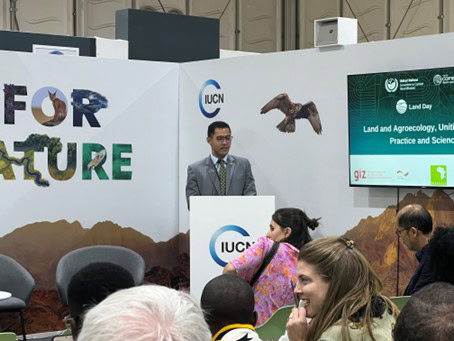
At the ongoing United Nations Convention to Combat Desertification (UNCCD) COP16 in Riyadh, experts gathered to discuss the critical role of agroecology in addressing land degradation and desertification challenges. The event featured the launch of a new GIZ factsheet detailing how agroecological approaches can support UNCCD objectives.
The event brought together key stakeholders from government, international organizations, and farming communities. HE Minister Max Andonirina Fontaine from Madagascar’s Ministry of Environment and Sustainable Development delivered an inspiring opening speech, setting the tone for meaningful dialogue.
Fiona Becker from Germany’s Federal Ministry for Economic Cooperation and Development (BMZ) presented governance perspectives, while Pascale Bonzom (IUCN) and John Garcia Ulloa (Biovision Foundation) offered insights from non-governmental actors. Esther Penunia from the Asian Farmers Association shared valuable on-the-ground experiences, highlighting the practical applications of agroecological principles.
Agroecology offers a holistic approach for transforming agriculture and food systems, which are highly dependent on land and its natural resources.
The discussions emphasized how the 13 agroecological principles provide a systematic framework for advancing land-based targets and combating desertification.
The newly launched factsheet demonstrates how agroecology can guide practical implementation of UNCCD objectives through sustainable land management practices that restore degraded landscapes while supporting biodiversity and rural livelihoods.
Download the factsheet here.